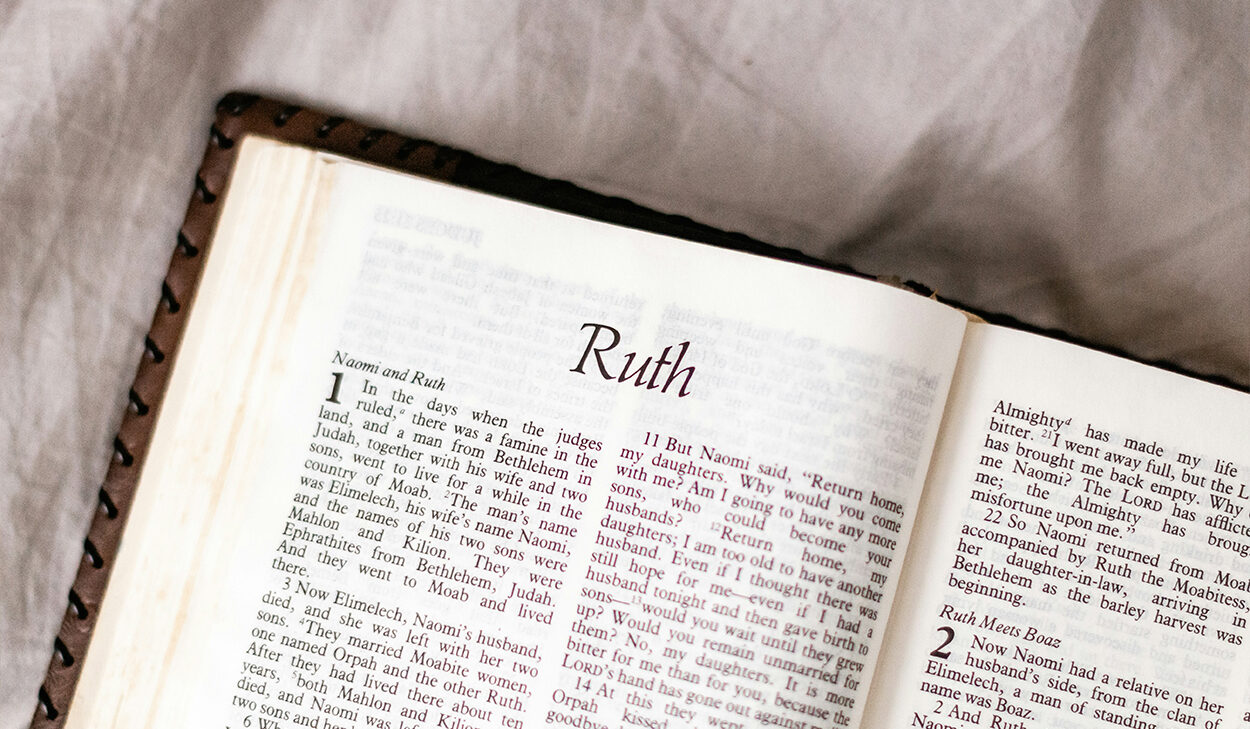

It was a heartbreaking scene. A woman had lost her husband and her two sons, and her daughters-in-law wept as she told them to go back to their families. She had no place in this foreign land; her best chances were to return to her own people. The daughters-in-law resisted at first, but the woman persisted. One eventually turned and left. The other remained. The next words out of this young, grieving widow’s mouth revealed that her allegiance extended far beyond any family ties.
“‘Where you go I will go, and where you stay I will stay. Your people will be my people and your God my God.’” -Ruth 1:16b
The story of Ruth is more than a romantic tale of finding love after tragedy. It’s a glimpse into how God openly welcomes people from all nations—even the nations that were once antagonistic toward Him and His people.
Ruth was a Moabite who had married an Israelite—ironic, given that the Moabites had a tainted history with the Israelites. The king of Moab was so afraid of the Israelites that he tried to hire a prophet to curse them (Numbers 22-24), Moabite women seduced Israelite men and convinced them to worship Baal (Numbers 25:1-2), and the Moabites were excluded from the assembly of the Lord because of these infractions (Deuteronomy 23:3-4). Yet in allowing the marriage of an Israelite and a Moabite, God provided a way for Ruth to learn about Him, and what she learned led to such a devotion that she was willing to leave her homeland to be with Naomi and her people.
It was in Judah that Ruth met Boaz, a kinsman redeemer from her father-in-law’s family (and from the lineage of Rahab). The first thing Boaz learned about Ruth was that she was a foreigner who had chosen to leave her people to be with Naomi. Because of her faithfulness, Boaz treated Ruth with generosity and kindness. And when he learned he was a kinsman redeemer, he was willing to marry Ruth. Boaz’s actions reflect God’s heart toward people from all nations. The Lord willingly cares for and redeems those outside of His chosen people.
In the Lord’s graciousness, a Gentile woman—a barren widow from an enemy nation—was grafted into the family of God. The Lord opened her womb, and her son became the grandfather of the future king of Israel.
“This is the genealogy of Jesus the Messiah the son of David … .” -Matthew 1:1
East-West Devotionals
Dive deeper into a collection of encouraging stories and devotionals by East-West Founder John Maisel and other authors that will spur you on in gratitude, worship, and obedience.